

Britain and France Plan to Send Troops to Ukraine if a Ceasefire Accord is Agreed

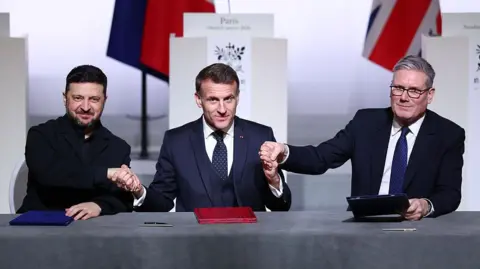
The London and Paris have inked a memorandum of understanding concerning the stationing of armed personnel in the nation should a peace deal be made with Russia, the UK Prime Minister, Starmer, has announced.
After talks with Ukraine's allies in the French capital, he indicated that the two nations would "set up defense centers throughout Ukraine and build protected installations for weapons and defense matériel" to deter any potential attack.
The partner countries also proposed that the United States would play the primary role in overseeing a truce.
The Kremlin has repeatedly cautioned that any external forces in Ukraine would be considered a "acceptable aim", but has as yet not commented on this latest announcement.
Background and Continuing Hostilities
Russian President Vladimir Putin initiated a comprehensive attack of Ukraine in early 2022, and Russian forces presently holds about 20% of Ukrainian territory.
"This is a vital part of our pledge to stand with Ukraine for the duration," stated Starmer.
National leaders and senior officials from the "Partner Group" participated in the Paris negotiations.
He stated at a shared media briefing, he further said: "It creates the pathway for the operational parameters under which British, French, and partner forces could work on Ukrainian soil, protecting Ukraine's skies and seas, and regenerating Ukraine's defense capabilities for the time to come."
The PM also stated that London would take part in any American-headed confirmation of a potential cessation of hostilities.
Security Guarantees and Negotiation Stances
Lead American diplomat Steve Witkoff stated that "durable security guarantees and robust economic promises are critical to a lasting peace" in Ukraine – mentioning a key requirement made by Kyiv.
Witkoff noted the partner nations had "substantially agreed on" their work on establishing such guarantees "so that the Ukrainian people know that when this conflict ends, it ends permanently."
Jared Kushner, ex-President Donald Trump's representative, also participated in the discussions.
Separately, France's leader Emmanuel Macron said that Ukraine's allies had made "significant progress" at the meeting.
He added that "strong" security guarantees for Kyiv had been agreed in the instance of a prospective ceasefire.
President Volodymyr Zelensky commented that a "major step forward" had been made in the talks, but qualified that he would only consider efforts to be "sufficient" if they led to the conclusion of the war.
Earlier, he indicated a peace agreement was "mostly finalized". Agreeing on the outstanding 10% would "determine the fate of the agreement, the future of Ukraine and Europe".
Unresolved Issues
- Sovereign soil and security guarantees have been at the heart of key disagreements for diplomats.
- The Russian President has consistently stated that Kyiv's military must withdraw from the entirety of Ukraine's eastern Donbas region or Russia will seize it, refusing any concession over how to conclude the war.
- Zelensky has so far rejected giving up any land, but has suggested that Ukraine could pull back its troops to an designated point – but only if Russia does the same.
Russia presently controls about 75% of the Donetsk oblast and around 99% of the bordering Luhansk region. The areas form the industrial region of the Donbas.
The initial US-led comprehensive framework that was extensively reported to the media last year was seen by Ukraine and its European allies as being strongly biased in Moscow's favor.
This triggered weeks of high-level negotiations – with Ukraine, the US and European leaders trying to adjust the proposal.
The previous month, Ukraine presented the US an revised proposal – as well as separate documents describing possible security guarantees and provisions for Ukraine's recovery, the President said.